
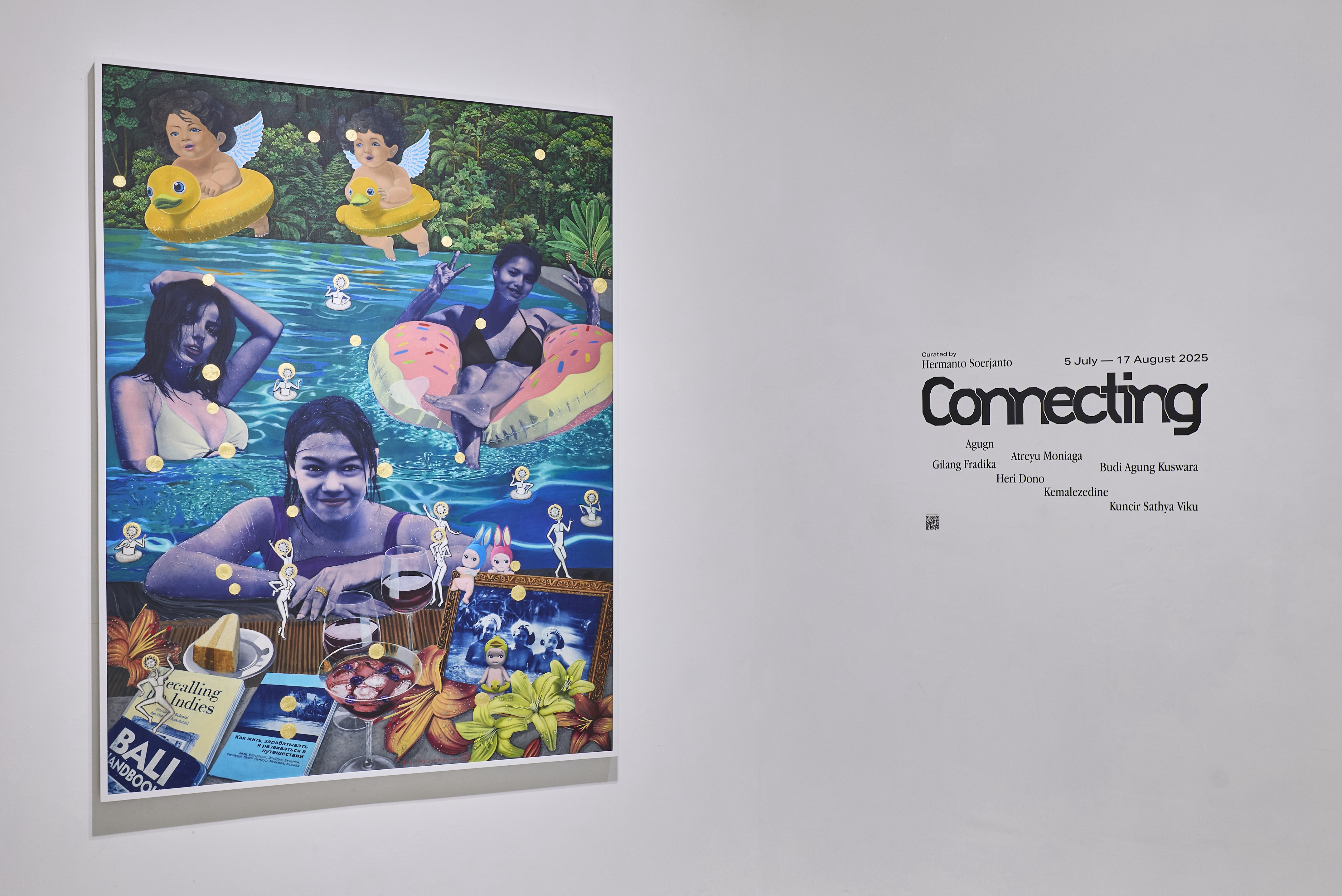
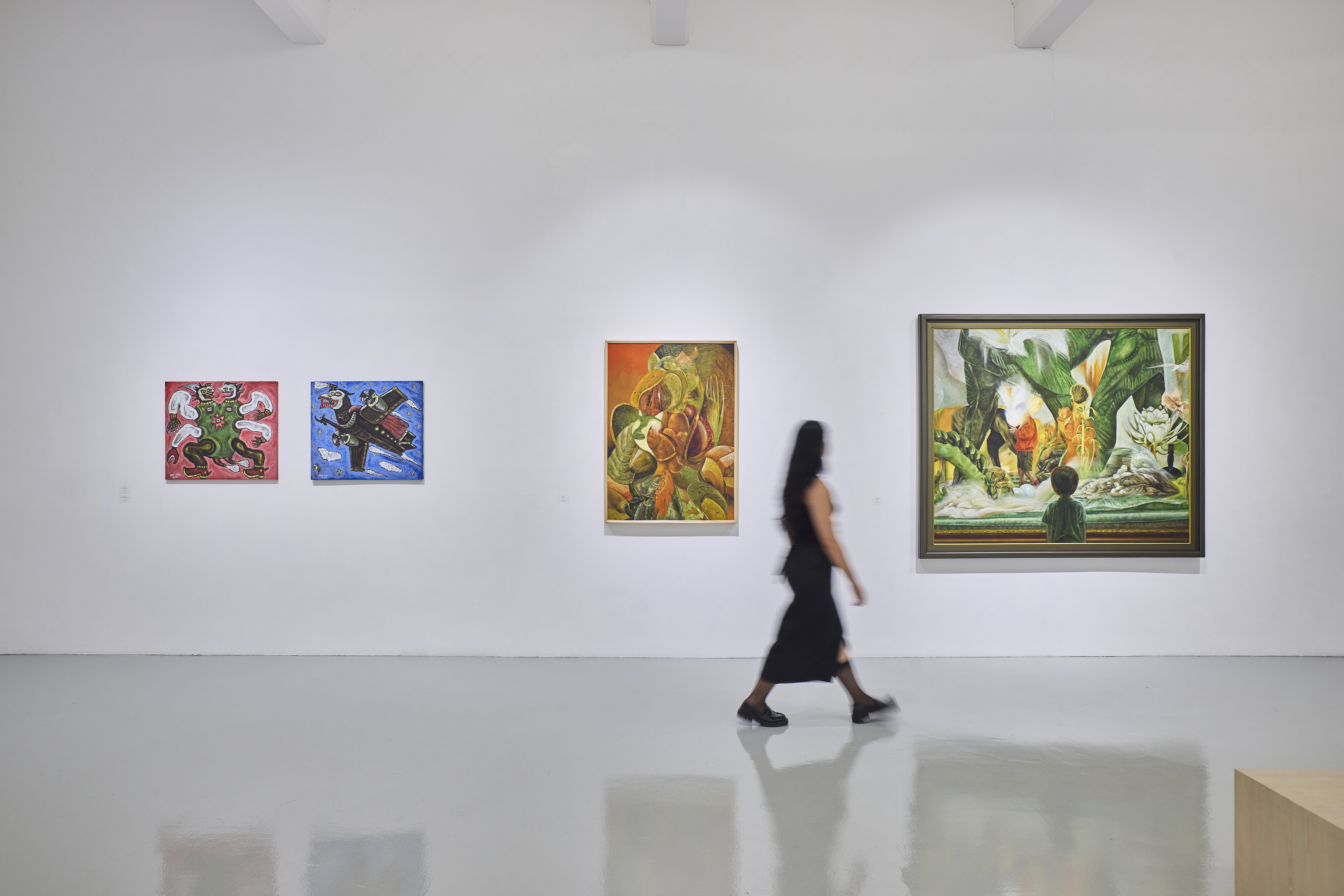
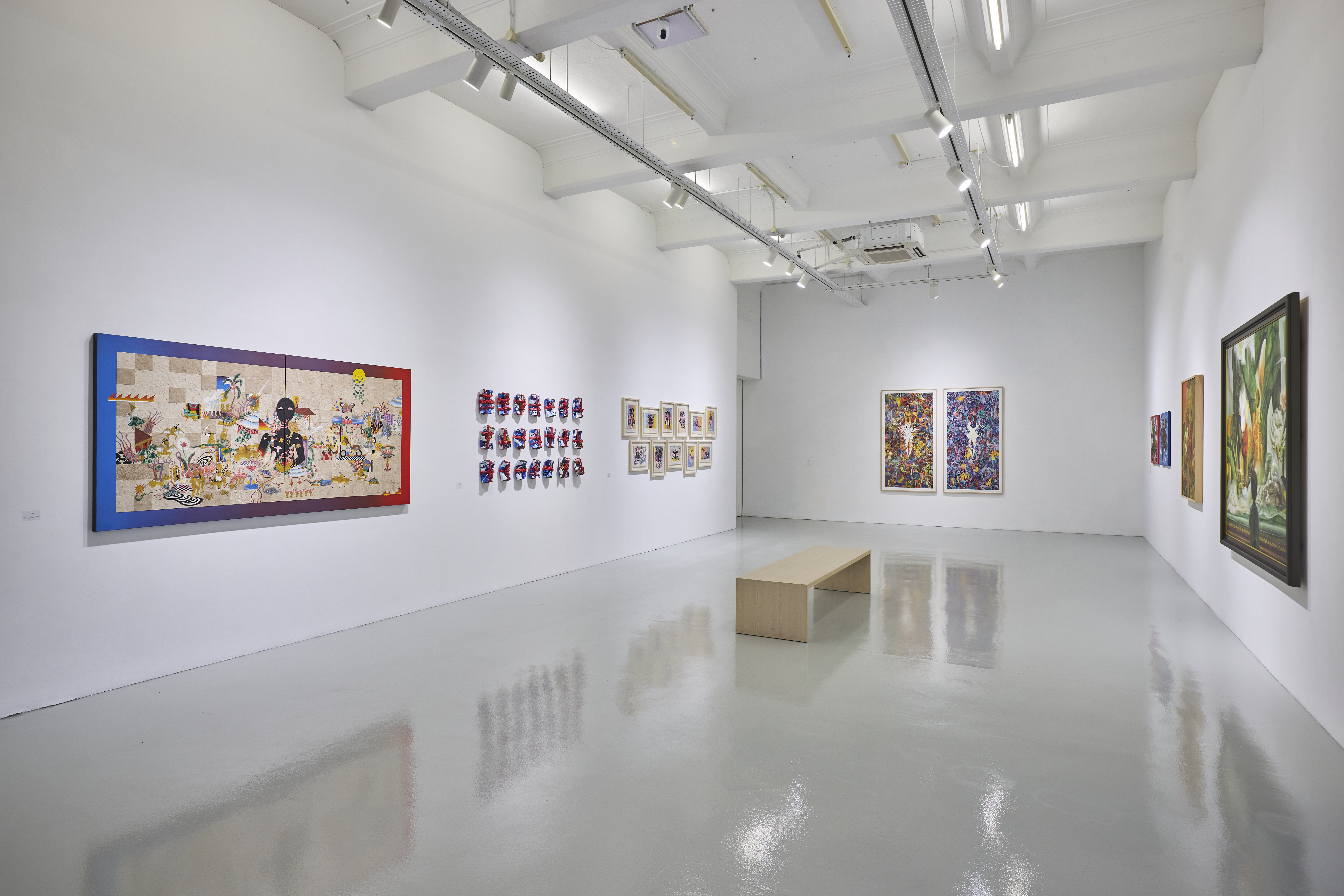
We celebrate the recently opened group exhibition Connecting, on view at Mizuma Gallery Singapore from 5 July to 17 August 2025, by shining a spotlight on Budi Agung Kuswara’s work where sunlight, Artificial Intelligence (AI), and colonial archives come together to explore how identity shifts across generations. What can these tools reveal about memory, time, and the stories we inherit?
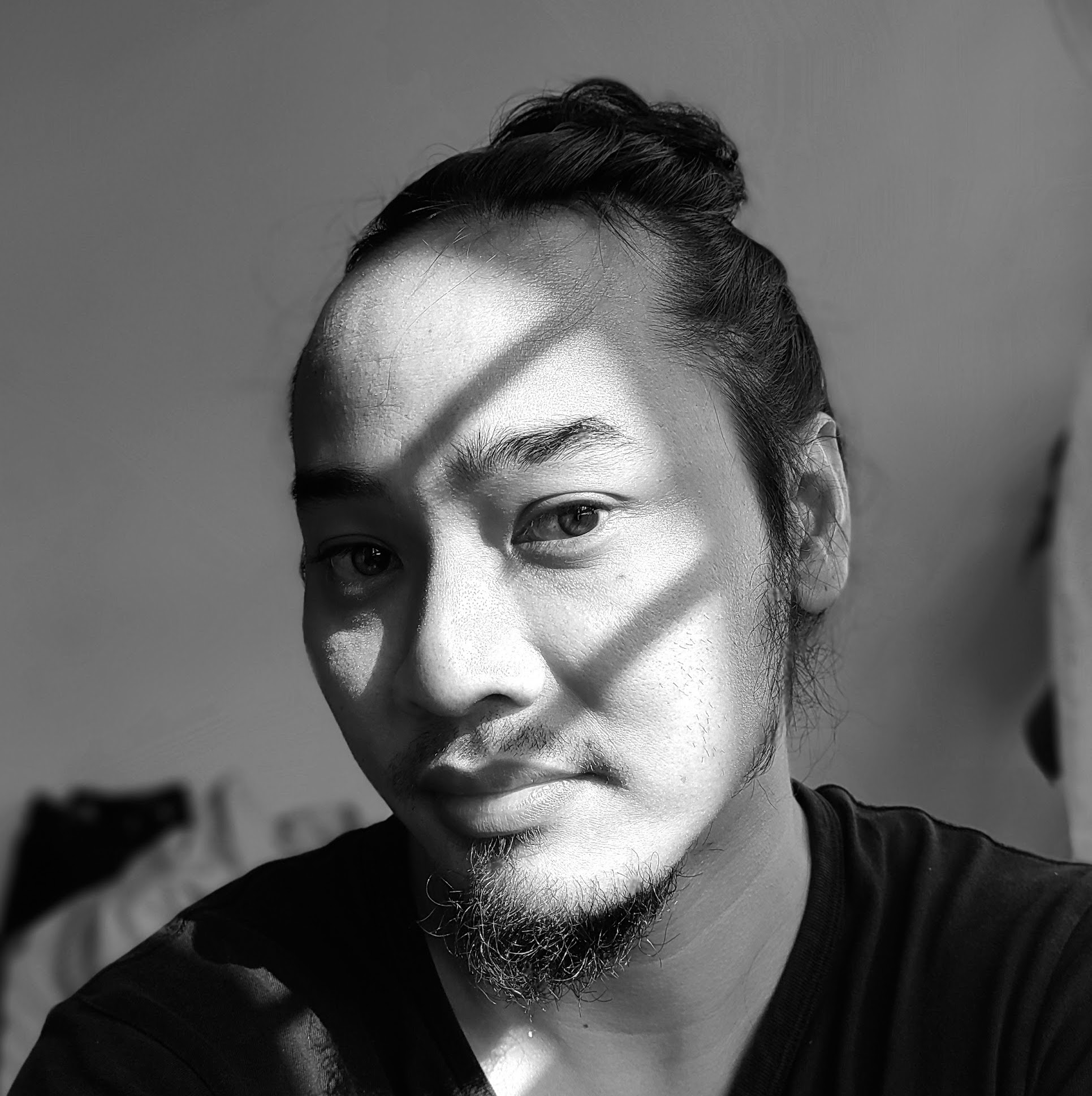 Budi Agung Kuswara (b. 1982) is a Balinese artist whose work weaves together traditional techniques, digital technology, and archival imagery to explore cultural memory and shifting identity. Working primarily with cyanotype, a historic printing method developed through sunlight, he prints AI-generated portraits of imagined descendants from colonial-era photographs, creating a quiet dialogue between past and present. Drawing from digital archives such as the Leiden University, Tropenmuseum, and Rijksmuseum, Kuswara selects images open to multiple interpretations, using them to surface silenced narratives and question how history has been classified and remembered.
___________
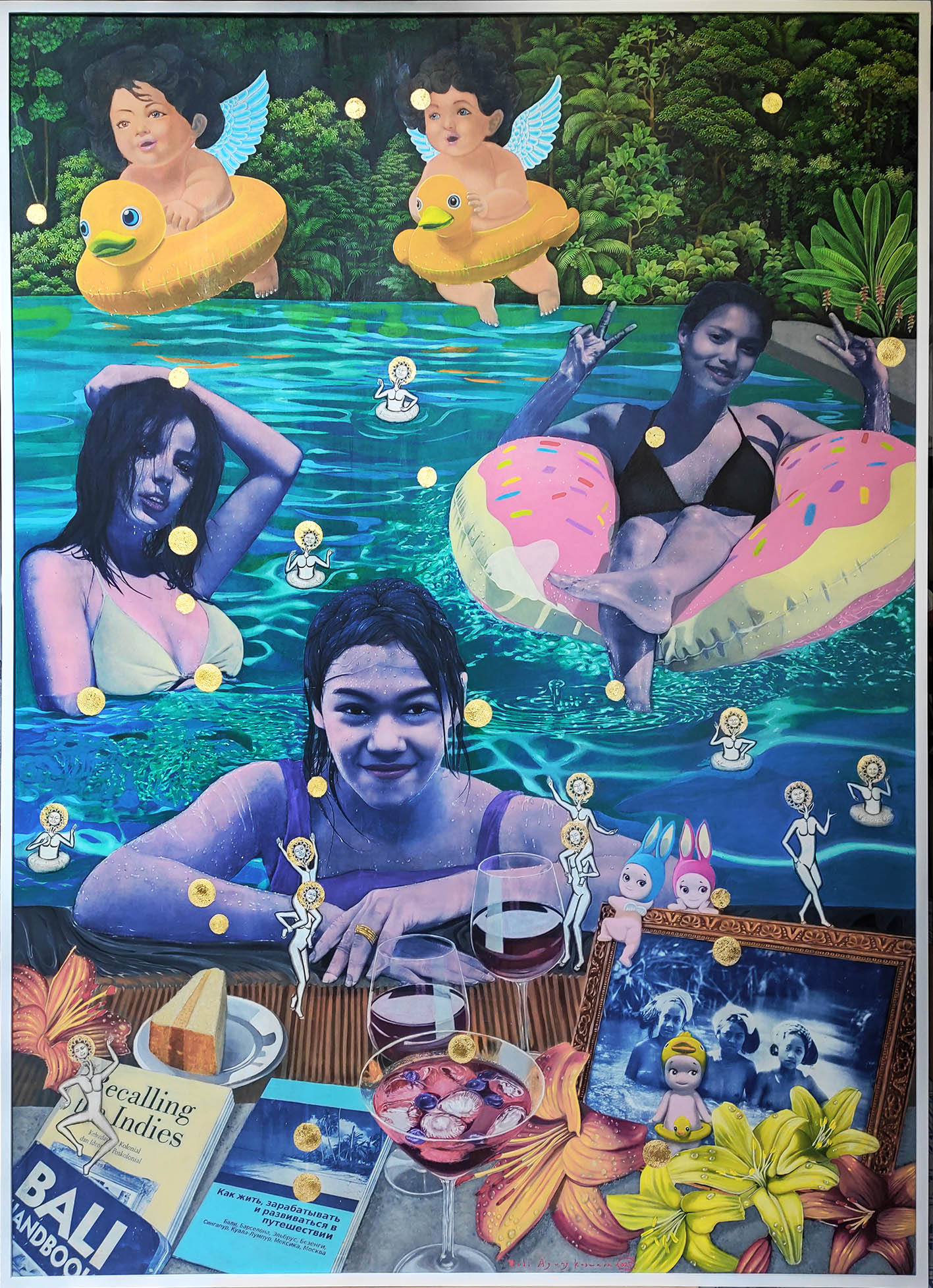
Budi Agung Kuswara, Reunion in the Pool of Time (The Descendent Emerge series), 2025, cyanotype on canvas, 200 × 145 cm
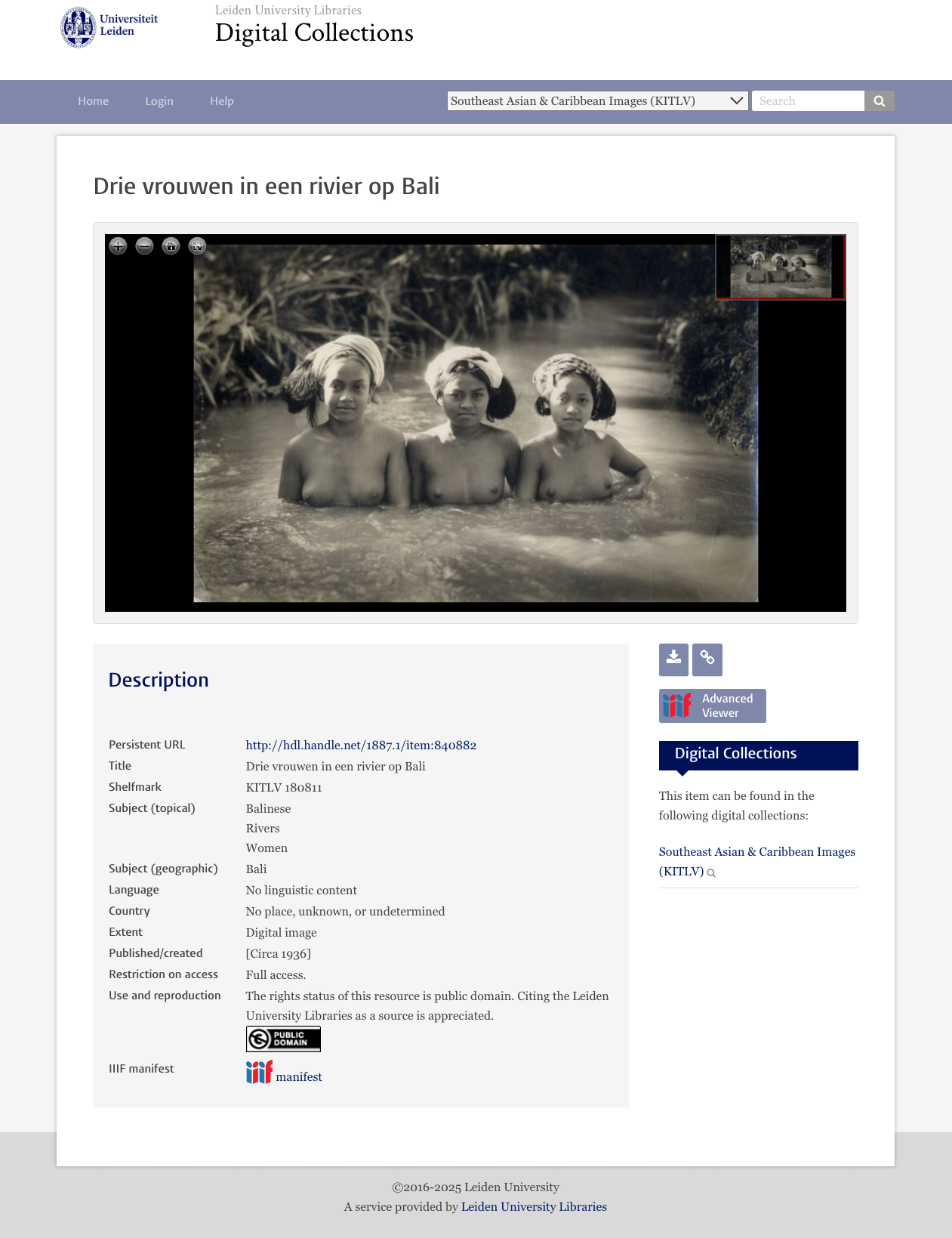
Screenshot of the Leiden University Libraries, Digital Collection of the archival photograph Drie vrouwen in een rivier op Bali (Three women in a river in Bali) as reference image for artwork “Reunion in the Pool of Time (The Descendent Emerge series), 2025” , accessed on July 17, 2025 (Image credit: https://digitalcollections.universiteitleiden.nl/view/item/840882)
Artist Statement
Reunion in the Pool of Time (The Descendant Emerge series), 2025, imagines a cross-generational encounter between the (fictional) fourth-generation descendants of three Balinese girls once captured in a colonial era photograph. In the past, their ancestors lived under the shadow of foreign rule, a time when Bali was viewed from the outside as exotic, yet rarely truly heard.
Now, their descendants appear in a very different scene. They lounge in a clear blue pool, surrounded by bright colours, donut-shaped floaties, glasses of wine, and global cultural symbols. They belong to a generation shaped by international currents that is more free, more open, and yet, more complex.
The old photograph in the corner serves as a quiet reminder of a past that still lingers, even if unnoticed. Cherubic figures, tourist objects, and playful icons add layers to the narrative, suggesting how Bali continues to shift and evolve with time.
This work invites reflection on the relationship between past and present how memory, legacy, and identity continue to transform. In the midst of all the change, the new generation still carries the shadows of those who came before. But amid the rhythms of tourism and the steady flow of global influence, one question remains: has Bali truly emerged from the shadow of foreign power?
___________
In the Q&A below, Budi reflects on the poetic and symbolic role of the sun, the meaning of working with AI, and what it means to be a young Balinese artist navigating the past and future.
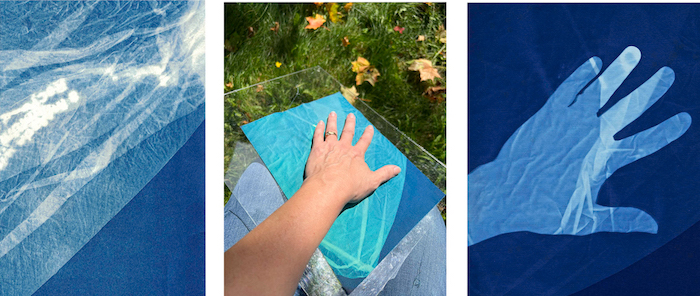
Cyanotype printing process, exposure to sunlight (Image credit: https://www.alternativephotography.com/double-exposure-cyanotype/)
Mizuma Gallery: You work with cyanotype, a historic printing technique that uses sunlight to develop deep blue images since 2010 in a project that involved printing images on fabric. Why did this process stay in your practice, and how do you see its potential in your practice?
Budi Agung Kuswara: I first began using cyanotype for its ability to print on fabric, specifically for a project that required that material quality. But as I continued working with it, I found myself diving deeper into the process of each exposure, each wash revealing not only an image, but also a growing sense of connection.
Cyanotype is a poem recorded by light.
I chose this technique because it offers me a direct, embodied experience of time. Every time I face the sun, I feel the turning of the cosmos, a cycle we, as humans, have long used to measure and mark our lives. Cyanotype is not merely a printing method; it is a process that carries this cosmic rhythm into the work itself. In my practice, cyanotype becomes a way to sense and record time, not just to produce an image.
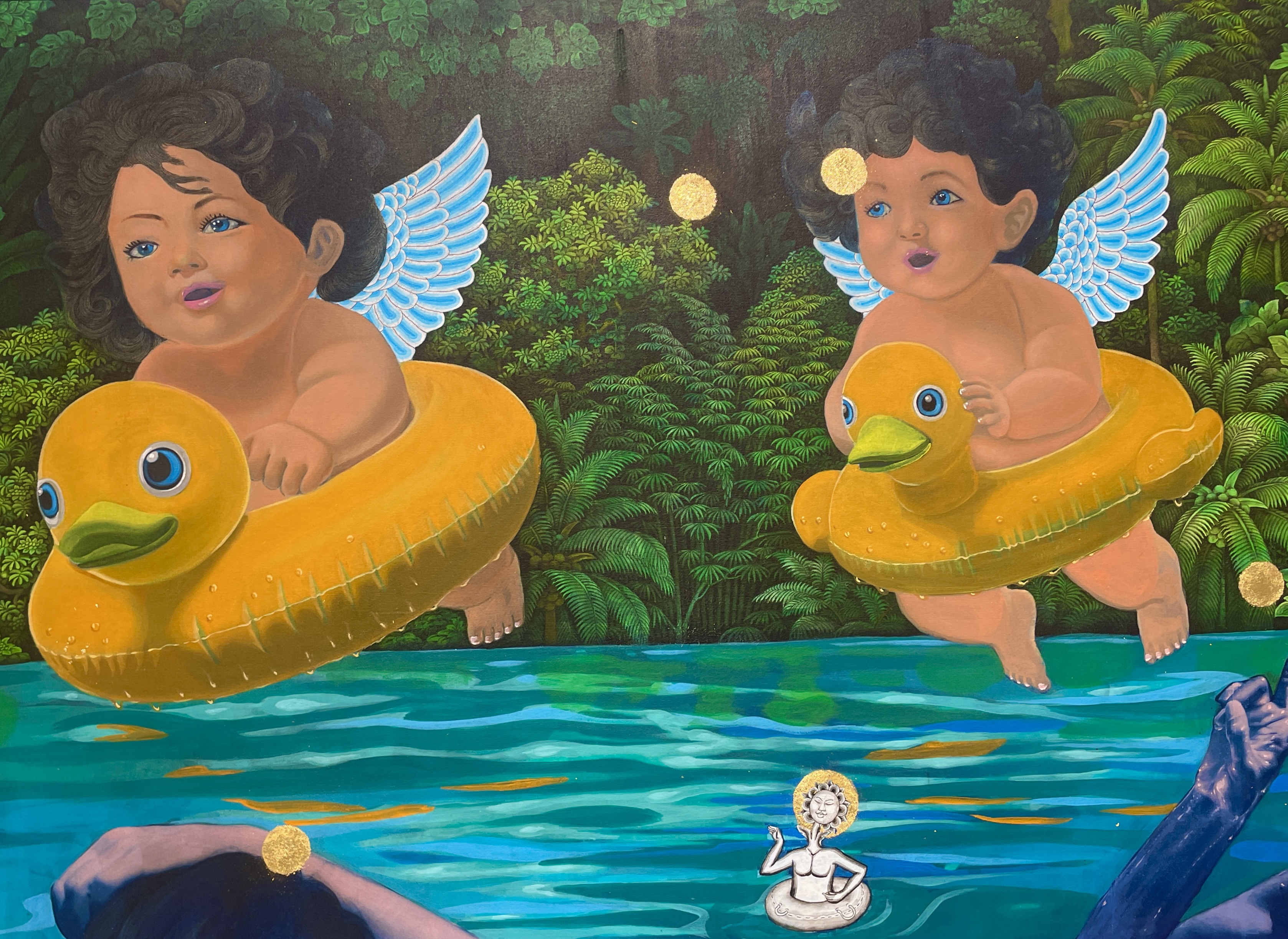
Detail image of “Reunion in the Pool of Time (The Descendant Emerge series), 2025”
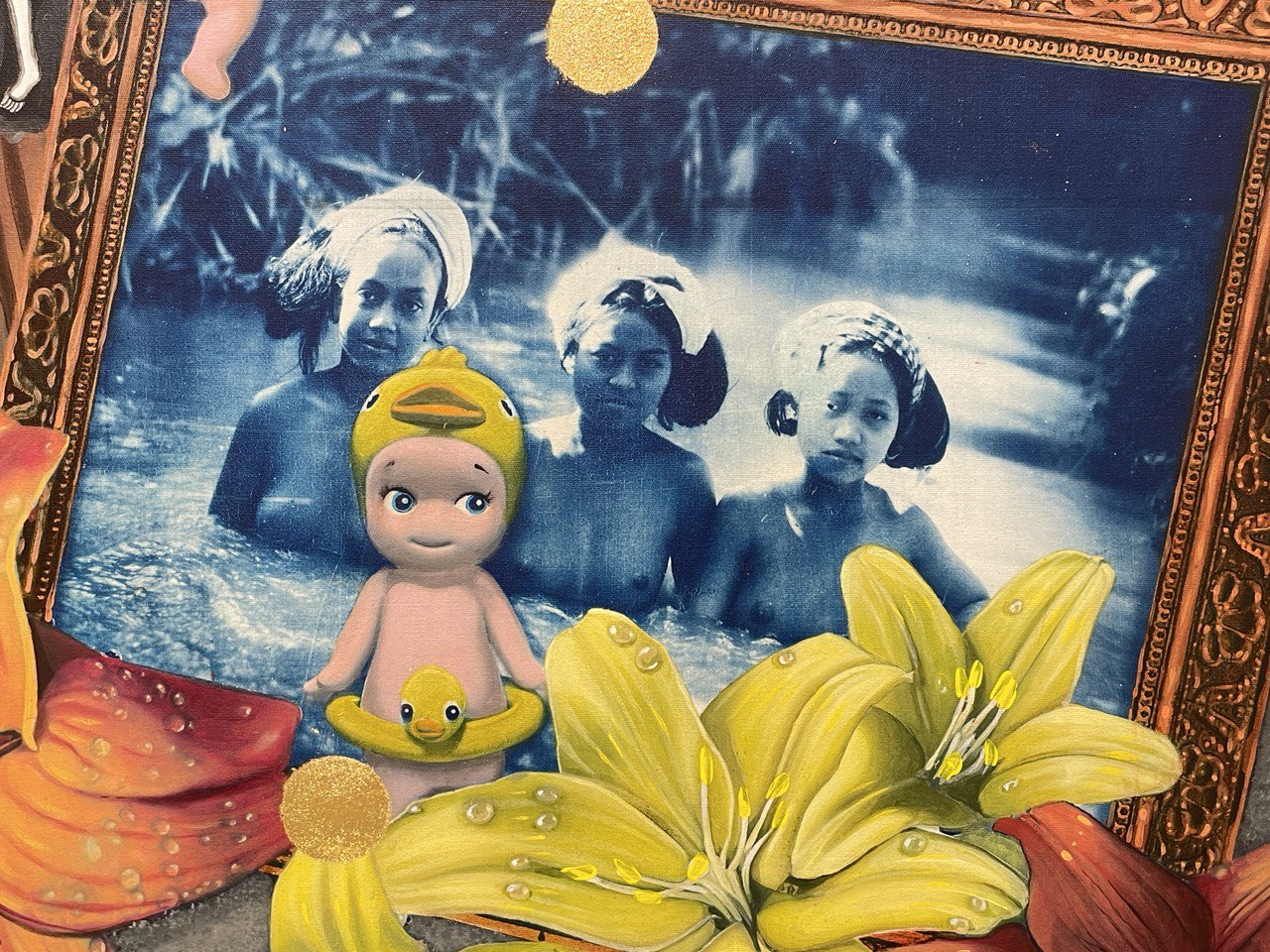
Detail image of “Reunion in the Pool of Time (The descendant emerge series), 2025”
Mizuma Gallery: In the painting, Reunion in the Pool of Time (The Descendant Emerge series), 2025, the sun acts as both a literal and symbolic force—used to develop prints, strengthen visual effects along with painting, but also as a link across all generations. Especially in Balinese culture where the sun carries spiritual meaning, what is the symbolism of the sun to you and your work
Budi Agung Kuswara: For me, the sunlight is the source of the visuals. Without light, there would be no images, no visibility. In Balinese culture, the sun holds a central place in spirituality as a masculine energy: one that gives life, purifies, and watches over. In Reunion in the Pool of Time, the sun appears not only as a physical light that develops the image, but also as a spiritual light guiding a narrative across generations. It becomes a symbol of connection between the seen and the unseen, the past and the future.
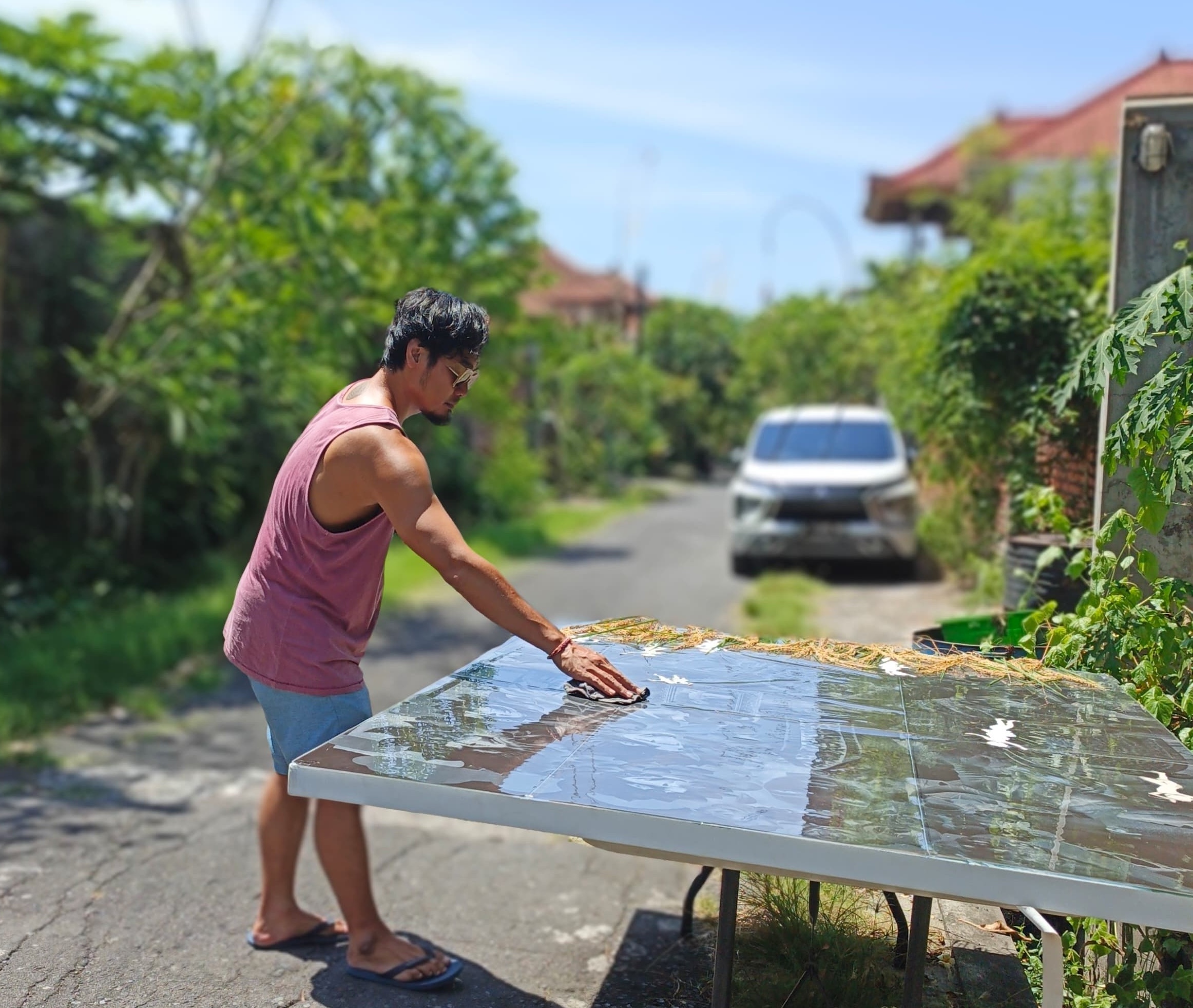
Budi Agung Kuswara exposing a cyanotype with an arrangement on padi rice and grass under the sun at his studio in Bali. Photo taken in 2025.
Mizuma Gallery: Cyanotype printing requires time under the sun to form an image, which feels especially resonant in a practice concerned with history and legacy. How does this slow, light-based process relate to your way of thinking about memory?
Budi Agung Kuswara: Memory, like cyanotype, needs time to surface. It cannot be forced. The cyanotype process teaches me not to rush to see clearly, one must wait for light to arrive from the right direction. In my work, memory is not only about nostalgia. This technique becomes a bridge between the past and the present. Its potential is not just aesthetic, but spiritual because it records traces, not merely forms.
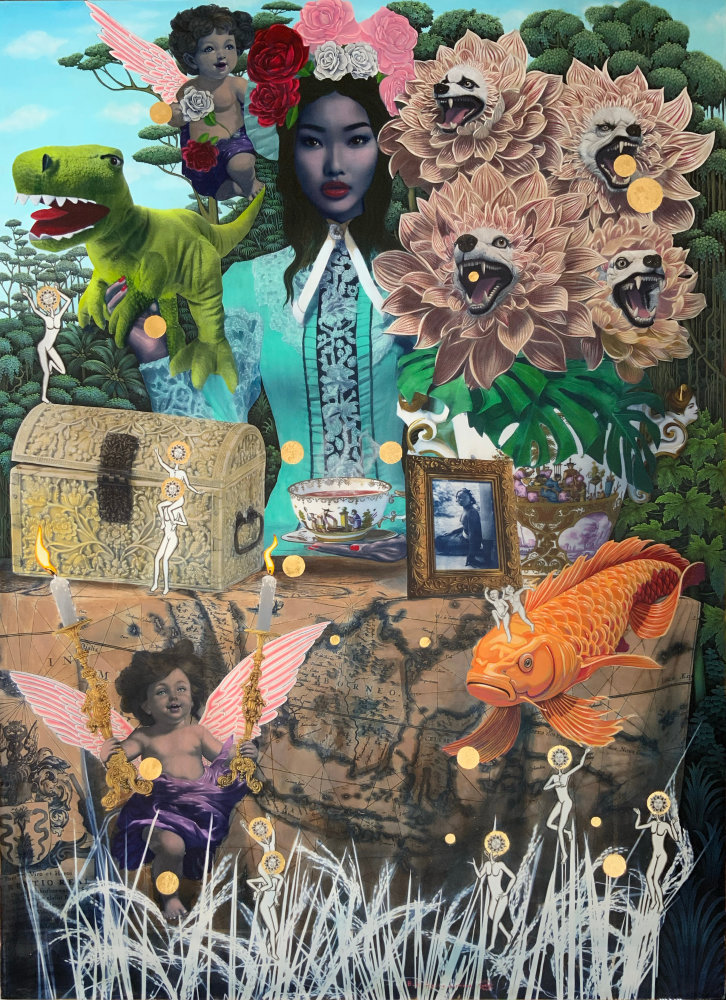
Budi Agung Kuswara, Generasi Indonesia Emas #2 (from the Tiba Anak Cucu series), 2024, cyanotype, acrylic, ink, gold leaf 24k on canvas 200 × 145 × 5 cm,
Mizuma Gallery: While you use digital tools like AI to generate fictional descendants from colonial archival photographs, the process of creating on canvas starts from a layer of the final image printed under natural sunlight, then further enhanced with painting. What does this blending of digital data, elemental exposure and classical painting mean to you in storytelling?
Budi Agung Kuswara: I am drawn to the tension between the artificial and the natural. When I use AI to generate “fictional descendants” from colonial archival photographs, I recognize the power in recreating figures that have long been framed by colonial narratives. I then expose them under sunlight, a kind of baptism by light before painting them by hand. This is not just technical; it is a way to reweave imaginations that have been flattened by power. Through this fusion of technology and elemental forces, I aim to bring forth voices that have been silenced through a visual language that is intimate and honest.
![Reference image of “Generasi Indonesia Emas #2 (from the Tiba Anak Cucu series), 2024 ” (Title: Studioportret vrouwen op Bali, Subject: (topical) Balinese Women, Subject: (geographic) Bali, Language: No linguistic content, Country: No place, unknown, or undetermined, Published/created: [Circa 1920]. Image courtesy of Darren Soh.](https://www.mizuma.sg/wp-content/uploads/2025/07/SEA_Focus_7RV0401.jpeg)
Reference image of “Generasi Indonesia Emas #2 (from the Tiba Anak Cucu series), 2024 ” (Title: Studioportret vrouwen op Bali, Subject: (topical) Balinese Women, Subject: (geographic) Bali, Language: No linguistic content, Country: No place, unknown, or undetermined, Published/created: [Circa 1920]. Image courtesy of Darren Soh.
Budi Agung Kuswara: This experience feels like dancing with shadows. I have to remain alert, so as not to fall into the visual stereotypes produced by global systems. But this is precisely where subversive space opens up. By recognizing the biases embedded in the algorithm, I use Midjourney not to imitate, but to sabotage. I insert fragments of local values, spiritual symbols, and personal interpretations, then pull them into the space of light and into my own hands. As a young Balinese artist, I see this as a way to engage in dialogue with the past while rewriting the future.
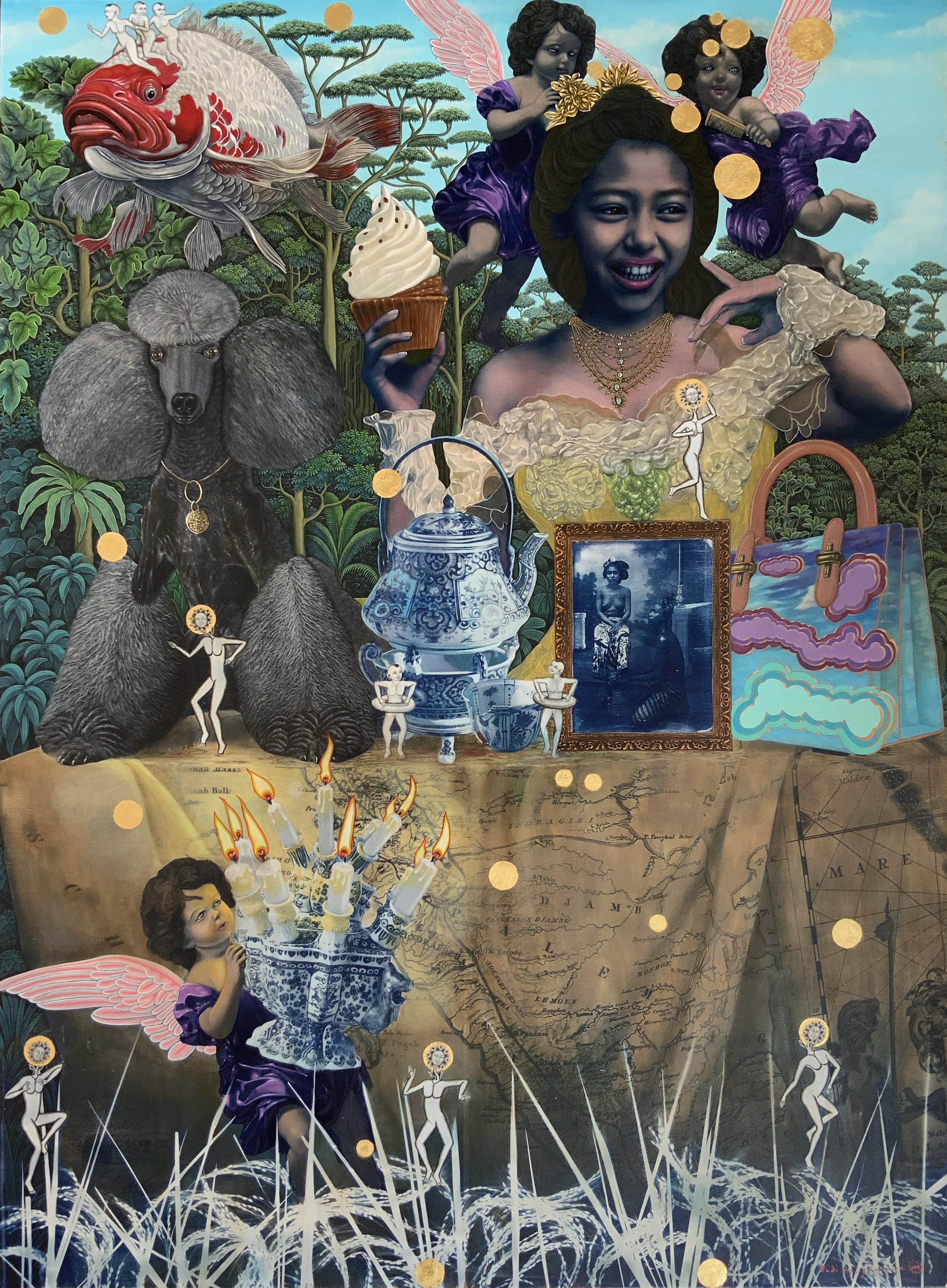
Budi Agung Kuswara, Generasi Indonesia Emas #1 (from the Tiba Anak Cucu series), 2024, cyanotype, acrylic, ink, gold leaf 24k on canvas, 200 × 145 × 5 cm.
![Reference image of “Generasi Indonesia Emas #1 (from the Tiba Anak Cucu series), 2024” (Title: Studioportret vrouwen op Bali, Subject: (topical) Balinese Women, Subject: (geographic) Bali, Language: No linguistic content, Country: No place, unknown, or undetermined, Published/created: [Circa 1925]. Image courtesy of Darren Soh.](https://www.mizuma.sg/wp-content/uploads/2025/07/SEA_Focus_7RV0403.jpeg)
Reference image of “Generasi Indonesia Emas #1 (from the Tiba Anak Cucu series), 2024” (Title: Studioportret vrouwen op Bali, Subject: (topical) Balinese Women, Subject: (geographic) Bali, Language: No linguistic content, Country: No place, unknown, or undetermined, Published/created: [Circa 1925]. Image courtesy of Darren Soh.
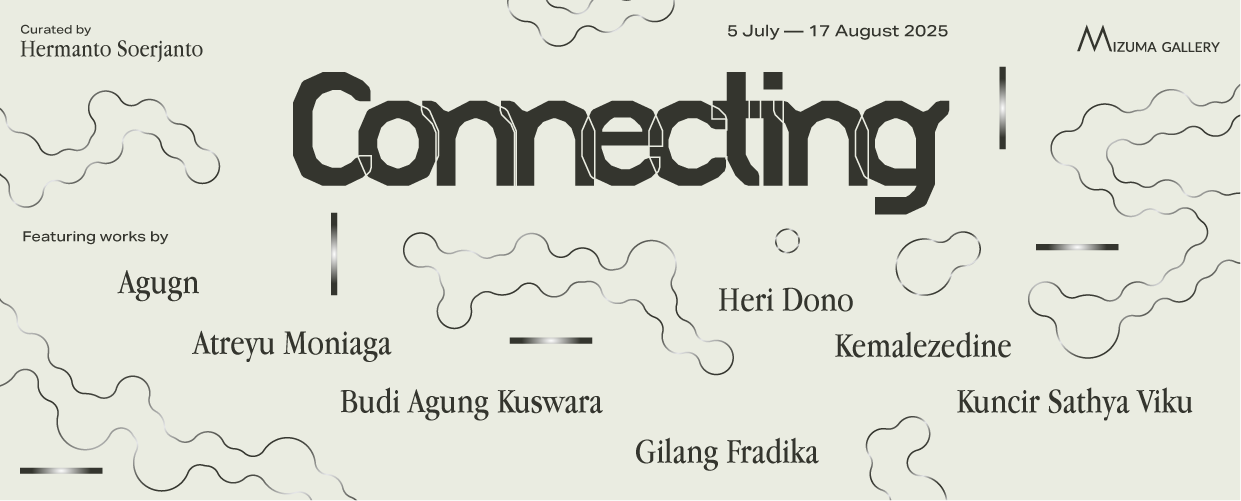
Connecting is a group exhibition that brings together seven contemporary Indonesian artists whose practices explore the many ways connection can emerge between people, ideas, materials, and environments. Curated by Hermanto Soerjanto, the exhibition reflects on the notion that connection is fundamental to all life, shaping our sense of purpose and grounding our presence in the world. The exhibition runs from 5 July to 17 August 2025 at Mizuma Gallery Singapore.
About the Artist
Budi Agung Kuswara (b. 1982, Bali, Indonesia) graduated with a Bachelor in Fine Arts from the Indonesia Institute of Arts (ISI), Yogyakarta, Indonesia in 2009. Trained in kamasan painting, Budi retains the intricacy and delicate linework of this traditional art form in his contemporary works. His paintings celebrate the treasury of aesthetic and cultural influences on the Indonesian archipelago, marrying these baroque sensibilities with observations on social tensions and dynamics. His notable exhibitions include Repose: Under The Sun at Kiniko Art Room, Yogyakarta, Indonesia (2023), Residual Memory at Mizuma Gallery, Singapore (2021); Arus Berlabuh Kita at the Asian Civilization Museum, Singapore (2018); Love Me in My Batik at ILHAM Gallery, Kuala Lumpur, Malaysia (2016); and The Wax on Our Fingers, a collaboration with Singaporean artist Samantha Tio (Mintio) at the Indonesian Contemporary Arts Network, Yogyakarta, Indonesia (2012); and his first solo exhibition, i.self at Komaneka Fine Art Gallery, Bali, Indonesia (2009). He has also undertaken residencies at Bamboo Curtain Studio, Taipei, Taiwan (2016); Fukuoka Asian Art Museum, Fukuoka, Japan (2012); and TAKSU, Kuala Lumpur, Malaysia (2012). Budi Agung Kuswara lives and works in Singapore and in Bali, Indonesia, where he co-founded Ketemu Project Space, a visual collective and social enterprise hybrid with focus on social engagement.
—
This interview took place through email exchanges between Mizuma Gallery and Budi Agung Kuswara in July 2025.
Copyright and Image Credits:
© Budi Agung Kuswara, image courtesy of the artist and Mizuma Gallery



