
On this edition of Artist Insights, we sit down with Ari Bayuaji, who recently presented a large-scale installation at Art Basel Hong Kong 2026, as part of the Encounters presentation at the art fair. The installation featured works from his Weaving the Ocean project, in which he creates artworks using fibers unraveled from discarded fishing ropes.
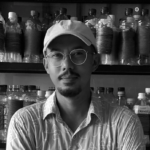 Ari Bayuaji (b. 1975, Mojokerto, Indonesia) trained as a civil engineer and worked in Indonesia before moving to Canada in 2005. He graduated in Fine Arts from Concordia University in Montreal in 2010 and now lives between Montreal and Bali. Ari is known for his art installations, which incorporate found and ready-made objects to convey aspects of daily life within a culture. Ari’s notable exhibitions include Indian Ocean Craft Triennial, John Curtin Gallery, WA, Australia (2024); Cheongju Craft Biennale, Cheongju Culture Factory, Cheongju, South Korea (2023); RiverRun Festival, John F. Kennedy Performing Arts Center, Washington, USA (2023), amongst others. His works are part of the Musée d’art contemporain de Montréal, Montreal, Canada; Musée des Beaux Arts de Montréal, Montreal, Canada; and Musée National du Québec, Québec City, Canada.
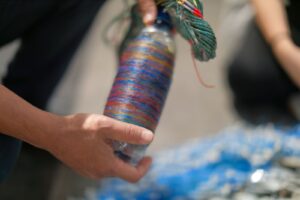
Working with the local community in Sanur, Ari collected discarded ropes and explored their application in art making. The ropes were gathered from the coastline, washed using recycled water from local laundries and hotels, then dried and unraveled into fibers. These fibers were subsequently spooled into long threads for weaving, with plastic bottles repurposed as spools and bobbins.
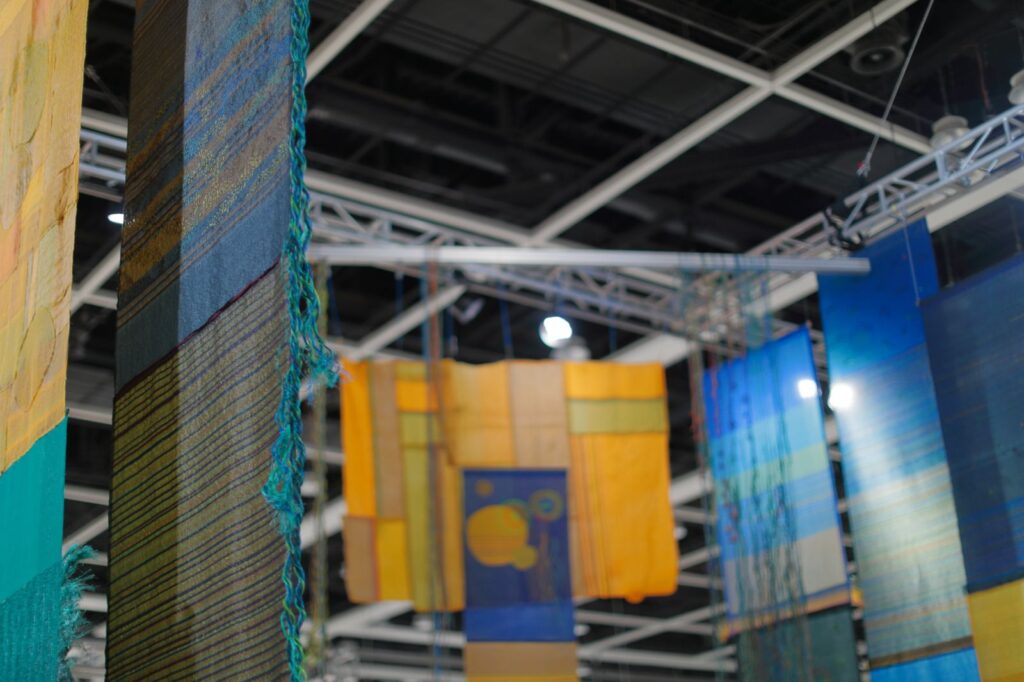
Weaving of the textiles was carried out collaboratively by Ari and his weaving assistant. The layers and colours of each weave vary, resulting in unique textile pieces. Ari then adds various details, ranging from embellishments of semi-precious stone beads and mother-of-pearl sourced from jewelry stores in Bali, to sun patterns crocheted from plastic threads that emphasise the versatility of the material. In his recent installation, he also introduced plastic threads as a medium for embroidery. Using a technique similar to Japanese boro stitching, an image of the Balinese mythological figure Rangda was brought to life on textile, forming depth and dimensionality through the stitching.
The installation also included a sculptural work. Building on a previous piece, Blue and White Shrine, Ari presented ceramic shards salvaged from shipwrecks in the seas of Bali alongside plastics corals and threads. The use of human-made objects discarded into the sea across different periods creates a historical juxtaposition and prompts viewers to reconsider their relationship with the oceans.
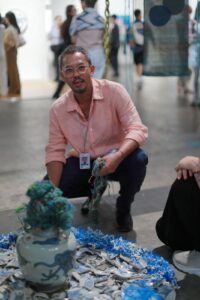
Photography by Lynn Liu, courtesy of Lynn Liu and Mizuma Gallery
“Weaving the Ocean began with the idea of replacing vanishing natural materials with new “natural” materials that can be found easily. One day, I discovered an abundant supply of plastic ropes tangled in the roots of mangrove trees near Sanur on the coast of Bali. Entwined with the roots, the plastic rope appeared almost to be like a naturally growing part of the trees. This discovery led me to use the plastic threads as a material for weaving. Plastic is so abundant in our environment these days that it has essentially now became a major element of the natural world. Our lives have become entangled with plastic products in much the same fashion as the coral that I found growing on plastic ropes along the shoreline of Sanur.”
– Ari Bayuaji
In the Q&A below, Ari Bayuaji discusses his Encounters presentation, and his artistic evolution with the Weaving the Ocean project.
Mizuma Gallery: It’s been a few weeks since the fair concluded. If you were to summarize the Weaving the Ocean installation in a short statement, what would it be?
Ari Bayuaji: The art installation was an invitation for the audience to look more closely at the artworks that constructed the whole installation. People could walk around the installation and had the opportunity to better understand the materiality of the artworks. I think it was a great experience for visitors at Art Basel Hong Kong.
Mizuma Gallery: You have created many large-scale installations with the Weaving the Ocean series in recent years. What makes this installation at Art Basel Hong Kong 2026 distinct from your previous installations?
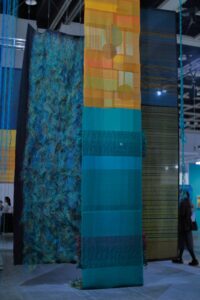
Installation view of Weaving the Ocean at Art Basel Hong Kong Encounters, 2026. Photography by Lynn Liu, courtesy of Lynn Liu and Mizuma Gallery.
Ari Bayuaji: Art Basel Hong Kong is a great stage for artists, collectors, curators, and visual art lovers from many different countries. Weaving the Ocean, as part of the Encounters sector at Art Basel Hong Kong 2026, is the biggest installation in the series and the most viewed installation (in less than a week of display) that I have done so far.
Mizuma Gallery: In hindsight, what were some of the challenges you faced when developing the installation?
Ari Bayuaji: We had very short hours to complete the whole installation. The time limit was very challenging, as I had to put everything together on the spot using a trial-and-error method. Luckily, I had a great team from Mizuma Gallery to help me during the installation process.
Mizuma Gallery: Your works have been presented in both art festivals, such as Roppongi Art Night (2025) and Bangkok Art Biennale (2024), as well as craft-based festivals like the Indian Ocean Craft Triennial (2024) and GO FOR KOGEI (2025). How do you see the relationship between ‘craft’ and ‘art’ in your practice?
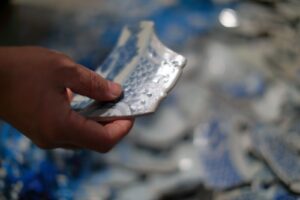
Photography by Lynn Liu, courtesy of Lynn Liu and Mizuma Gallery.
Ari Bayuaji: There is a very fine line between art and craft. The separation of art and craft started during the European Renaissance, and it was about intellectual and manual labour. I don’t see that separation in my work. My collaborators and I created the project by making artworks that balance a strong concept with a high aesthetic.
Mizuma Gallery: Weaving the Ocean series and its use of plastic threads have become a significant part of your practice. How has working with a specific material over time influenced your approach to found and ready-made materials?
Photography by Lynn Liu, courtesy of Lynn Liu and Mizuma Gallery.
Ari Bayuaji: Since the beginning of my artistic career, I have always been interested in ready-made objects as the material of my work. I used to work with old wood, metal, ceramic, etc. The first step would be to deconstruct them, then put them together again as a completely new form for the artworks. With the Weaving the Ocean series, the process is exactly the same. With my team, we deconstructed the plastic ropes by unravelling them into fine plastic threads, then reconstructed them by weaving them with cotton threads to create the final woven artworks.
Mizuma Gallery: Weaving the Ocean project started in early 2020 and has persevered for more than 6 years. How do you see this project evolving in the future?
Ari Bayuaji: We have been making a positive impact in the community in Sanur, Bali. I would like to develop the Weaving the Ocean project toward educational programmes for younger students in Bali. It would focus on environmental awareness and art as an economic solution, highlighting the Balinese people’s traditional skills before the tourism boom.
Installation view of Weaving the Ocean at Art Basel Hong Kong Encounters, 2026. Photography by Lynn Liu, courtesy of Lynn Liu and Mizuma Gallery.
Learn more about Ari Bayuaji’s Weaving the Ocean project:
View Art Bayuaji’s works on Artsy: https://www.artsy.net/artist/ari-bayuaji
For more information about Ari Bayuaji: https://www.mizuma.sg/artists/ari-bayuaji/



